
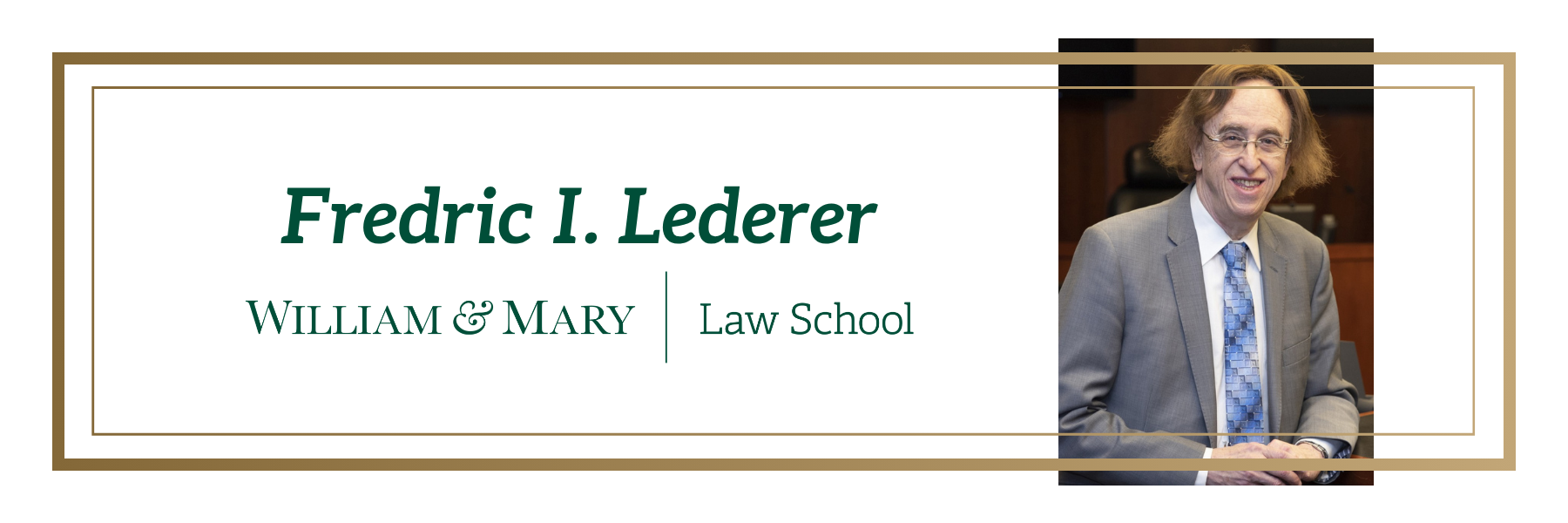
Chancellor Professor of Law and Director, CLCT
Areas of Specialization
Computers and the Law; Constitutional Law--4th, 5th, 6th Amendments; Criminal Law; Criminal Procedure Law; Evidence; Law Related Education; Law and Technology; Legal Research; Legal Skills; Legal Writing; Military Law; Practice of Law; Professional Responsibility; Trial Practice
Teaching Interests
Evidence and Applied Evidence; Technology-Augmented Trial Advocacy; Criminal Procedure; Electronic Discovery and Data Seizures; Military Law; Legal Skills
Representative Professional Activities and Achievements
Joined the faculty in 1980. Clerked for Judge Frederick P. Bryan, U.S. District Court for the Southern District of New York, held various legal positions with the U.S. Army including four years on the faculty of the Judge Advocate General's School and Army Member, Joint Service Committee on Military Justice Working Group. He was a Fulbright-Hays Scholar at the Max Planck Institut fur auslandisches und internationales Strafrecht, Freiburg, Germany.
Founder and director, The Center for Legal and Court Technology (formerly the Courtroom 21 Project) which includes in William & Mary's McGlothlin Moot Courtroom the world's most technologically advanced courtroom.
Virginia Bar Committee on Technology and Practice of Law (2007-present)
Public Member, 1996-99, "The Code Committee;" appointed in 1996 by the Secretary of Defense as one of two public members to join the Judge Advocates General and the judges of the United States Court of Appeals for the Armed Forces on this Congressionally created military law committee; co-chair, Code Committee Subcommittee on Technology.
Member, ABA Section of Criminal Justice, Committee on Rules of Criminal Procedure and Evidence, 1980-82 (Reporter, Article V - Federal Rules of Evidence, Subcommittee); 1983-2011.
Primary co-author, Executive Order No. 12198, March 12, 1980, promulgating the Military Rules of Evidence. See 8 M.J. LXVII (1980). Principal author of Military Rules of Evidence 301-316, codifying the law of confessions and admissions and search and seizure. Author of the Analysis of the 1980 Amendments to the Manual for Courts-Martial, MCM, 1969 (Rev. ed.) A18, reprinted in 8 M.J. LXVII.
Articles
AI-Based Evidence in Criminal Trials?, Sabine Gless, Fredric I. Lederer, and Thomas Weigend
(59 Tulsa Law Review 1-37 (2024))Problematic AI — When Should We Use It?, Fredric Lederer
(Harvard Advanced Leadership Initiative Social Impact Review (May 17, 2022))The Evolving Technology-Augmented Courtroom Before, During, and After the Pandemic, Fredric I. Lederer
(23 Vanderbilt Journal of Entertainment & Technology Law 301-339 (2021))A Legal Perspective on the Trials and Tribulations of AI: How Artificial Intelligence, the Internet of Things, Smart Contracts, and Other Technologies Will Affect the Law, Iria Giuffrida, Fredric Lederer, and Nicolas Vermeys
(68 Case Western Reserve Law Review 747-781 (2018))From Rome to the Military Justice Acts of 2016 and beyond: Continuing Civilianization of the Military Criminal Legal System, Fredric I. Lederer
(225 Military Law Review 512-539 (2017))Technology-Augmented Courtrooms: Progress Amid a Few Complications, or the Problematic Interrelationship Between Court and Counsel, Fredric I. Lederer
(60 New York University Annual of American Law 675-709 (2005))Courtroom Technology, A Judicial Primer, Fredric I. Lederer
(39 Judges' Journal 13-36 (2000))The Effect of Courtroom Technologies On and In Appellate Proceedings and Courtrooms, Fredric I. Lederer
(2 Journal of Appellate Practice and Process 251-274 (2000))Some Thoughts on the Evidentiary Aspects of Technologically Produced or Presented Evidence, Fredric I. Lederer
(28 Southwestern University Law Review 389-403 (1999))The Road to the Virtual Courtroom? A Consideration of Today’s -- and Tomorrow’s -- High Technology Courtrooms, Fredric I. Lederer
(50 South Carolina Law Review 800-844 (1999))Technology Augmented Litigation--systemic revolution, Fredric I. Lederer
(5 Information and Communications Technology Law 215-225 (1996))Does the Fourth Amendment Apply to the Armed Forces?, Fredric I. Lederer and Frederic L. Borch
Funeral Oration in Honor of United States v. Burton, Fredric I. Lederer
(1994 The Army Lawyer 40)Technology Comes to the Courtroom, and . . ., Fredric I. Lederer
(43 Emory Law Journal 1095-1112 (1994))The Military Rules of Evidence: Origins and Judicial Implementation, Fredric I. Lederer
(130 Military Law Review 5-39 (1990))Resolving the Frye Dilemma: A Reliability Approach, Fredric I. Lederer
(26 Jurimetrics Journal 240-244 (1986))Scientific Evidence - An Introduction, Fredric I. Lederer
The Procurement and Presentation of Evidence in Courts-Martial: Compulsory Process and Confrontation, Fredric I. Lederer and Francis A. Gilligan
(101 Military Law Review 3-82 (1983))Miranda v. Arizona: The Law Today, Fredric I. Lederer
(78 Military Law Review 107-163 (1977))Reappraising the Legality of Post-trial Interviews, Fredric I. Lederer
(1977 Army Lawyer 12-17)Replacing the Exclusionary Rule with Administrative Rulemaking, Francis A. Gilligan and Fredric I. Lederer
(28 Alabama Law Review 553-574 (1977))Rights Warnings in the Armed Services, Fredric I. Lederer
(72 Military Law Review 1-54 (1976))The Law of Confessions - The Voluntariness Doctrine, Fredric I. Lederer
(74 Military Law Review 67-97 (1976))U.S. v. McOmber, A Brief Critique, Fredric I. Lederer
(1976 Army Lawyer 5-7)Doing Away With the Exclusionary Rule, Francis A. Gilligan and Fredric I. Lederer
(1975 Army Lawyer 1-6)Absence without Leave - The Nature of the Offense, Fredric I. Lederer
(1974 Army Law Review 4-9)Admissibility of Evidence Found by Marijuana Detection Dogs, Fredric I. Lederer and Calvin M. Lederer
(1973 Army Lawyer 12-16)Marijuana Dog Searches After United States v. Unrue, Fredric I. Lederer and Calvin M. Lederer
(1973 Army Lawyer 6-12)Audio
Office Hours: The Robots Are Coming!, Jeffrey Bellin, Michaela Lieberman, Fredric I. Lederer, Nicolas Vermeys, and Iria Giuffrida
Blogs
On the Danger of Not Understanding Technology, Fredric I. Lederer
(New America, Public Interest Technology University Network (May 2, 2023))Court Record in the Age of Artificial Intelligence, Fredric I. Lederer
(Speech to Text Institute Newsletter (October 23, 2019))Books
Fundamental Criminal Procedure (2022 edition), Fredric I. Lederer
(Williamsburg, VA: [desktop published], 2022)Conferences
Special Challenges to 21st Century Lawyers: The Use and Misuse of Technology, Fredric I. Lederer, Richard K. Herrmann, Jan Michelsen, and Andrew Mertens
(Symposium on the Status of the Legal Profession: Facing the Challenges of the 21st Century (Georgetown University Law Center, Washington D.C. March 31-April 2, 2011))The Effect of Courtroom Technologies On and In Appellate Proceedings and Courtrooms, Fredric I. Lederer
The World of Courtroom Technology, Fredric I. Lederer
Courtroom Technology - An Introduction To The Onrushing Future, Fredric I. Lederer and Samuel H. Solomon
Modern Technology in the Courtroom: Possibilities and Implications, Fredric I. Lederer
Interviews
The Legality and Practicality of Remote Witness Testimony, Fredric Lederer
(20 Practical Litigator 19-30 (2009))Magazine Articles
Here There Be Dragons: The Likely Interaction of Judges with the Artificial Intelligence Ecosystem, Fredric I. Lederer
(59 The Judges' Journal 12-15 (Winter 2020))Improving Access to Justice via Technology, Fredric I. Lederer
(ABA Journal: Defending Justice Series (online) (May 17, 2018))Judging in the Age of Technology, Fredric I. Lederer
(53 The Judges' Journal 6-10 (Fall 2014))Holding Court: Eight Ideas to Help the Judiciary Make Wise Technology Decisions when Facing Severe Budget Cuts, Fredric I. Lederer
(Law Technology News 30-31 (June 2011))Courtroom Technology, Fredric I. Lederer, Tom O'Connor, and Timothy A. Piganelli
(25 GPSolo 44-47 (2008))Enhancing Courtroom Presentation Through Technology, Fredric I. Lederer
(57 Virginia Lawyer 52 (2008))Remote Control, Fredric I. Lederer
High-Tech Trial Lawyers and the Court: Responsibilities, Problems, and Opportunities, Fredric I. Lederer
(52 Federal Lawyer 41-45 (2005))Courtroom Technology: For Trial Lawyers the Future is Now, Fredric I. Lederer
(19 Criminal Justice 14-21 (Spring 2004))The Courtroom 21 Project: Creating the Courtroom of the Twenty-First Century, Fredric I. Lederer
(43 Judges' Journal 39-43 (Winter 2004))The Courtroom Technology Wars are Here!, Fredric I. Lederer
(For the Defense 30-34 (December 2001))Courtroom Technology in the 21st Century, Fredric I. Lederer
(Trial 38-41 (July 1999))Courtroom Technology from the Judge's Perspective, Fredric I. Lederer
(35 Court Review 20-24 (Spring 1998))The Courtroom as a Stop on the Information Superhighway, Fredric I. Lederer
(71 Reform 4-9 (Spring 1997))Revolution in Courtroom Technology Presents Opportunity and Risk, Fredric I. Lederer
(Trial 86-90 (November 1994))News
Some Thoughts on Technology and the Practice of Law, Fredric I. Lederer
(The Bencher: a Quarterly Newsletter of the American Inns of Court Foundation (January/February 2014))Newsletters
Impractically Obscure? Privacy and Courtroom Proceedings in Light of Webcasting and Other New Technologies, Fredric I. Lederer and Rebecca Green
(41 Law Technology 10-50 (Summer 2008))Courtroom 21: A Model Courtroom of the 21st Century, Fredric I. Lederer
(6 Court Technology Bulletin 1, 5, 7 (January/February 1994))Reports
Analysis of Administrative Agency Adjudicatory Hearing Use of Remote Appearances and Virtual Hearings, Fredric I. Lederer and Center for Legal & Court Technology
Empirical Research Report: The Use of Technology in the Jury Room to Enhance Deliberations, Fredric I. Lederer
Symposium Articles
Introduction: What Have We Wrought?, Fredric I. Lederer
The Potential Use of Courtroom Technology in Major Terrorism Cases, Fredric I. Lederer