


Preview
Identifier
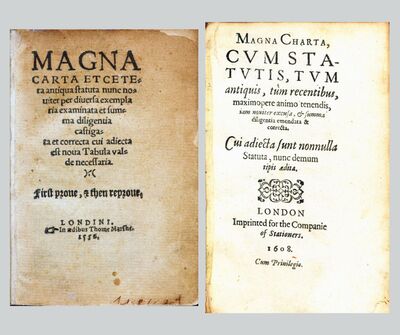
[left to right] KD 3948 .A2 M377 1556 and KD 3944 .A3 1608
Creation Date
1556
Description
[left to right]
Magna Carta et cetera Antiqua Statuta Nunc Nouiter per Diuersa Exemplaria Examinata et Summa Diligentia Castigata et Correcta Cui Adiecta est Noua Tabula Valde Necessaria. London: In Aedibus Thomas Marshe, 1556.
Magna Charta, Cum Statutis, Tum Antiquis, Tum Recentibus, Maximopere Animo Tenendis. London: Imprinted for the Companie of Stationers, 1608.
First printed around 1508 by Richard Pynson, multiple editions of the Magna Carta appeared in the sixteenth and seventeenth centuries. Antiquarians revived interest in the "Great Charter" during the sixteenth century, but it was during the seventeenth century that its political importance grew as writers used it against the Stuart monarchy. Following this intellectual thread, American colonists viewed Magna Carta as a document guaranteeing their liberties.
The 1556 edition is revised from the version printed by Thomas Berthelet in 1531 and includes other ancient statutes. This copy features a few scattered notes from a previous owner. The 1608 edition includes both ancient and contemporary statutes. The copy here also features notes from a previous owner as well as a signature on the rear free endpaper.
Title pages available as individual images under additional files, below.
Rights
Digital exhibit content is made available under CC BY-NC-SA.
Magna Carta, 1556 title page
magna_carta_1608_title.jpg (596 kB)
Magna Charta, 1608 title page
Keywords
Lapidus Collection